# Accumulators
[Converge (v1\\)x v1\\[x]](#converge) [v1 scan x](#keywords-scan-and-over)
[(v1/)x v1/[x]](#converge) [v1 over x](#keywords-scan-and-over)
[Do n v1\\x v1\\[n;x]](#do)
[n v1/x v1/[n;x]](#do)
[While t v1\\x v1\\[t;x]](#while)
[t v1/x v1/[t;x]](#while)
[Scan (v2\\)x v2\\[x]](#unary-application "binary value, unary application") [(v2)scan x](#keywords-scan-and-over)
[Over (v2/)x v2/[x]](#unary-application "binary value, unary application") [(v2)over x](#keywords-scan-and-over)
[Scan x v2\\y v2\\[x;y]](#binary-application "binary application")
[Over x v2/y v2/[x;y]](#binary-application "binary application")
[Scan v3\\[x;y;z]](#ternary-values "ternary") [x y\z](#alternative-syntax "alternative syntax")
[Over v3/[x;y;z]](#ternary-values "ternary")
---------------------------------------
v1, v2, v3: applicable value (rank 1-3)
n: integer≥0
t: unary truth map
x, y: arguments/indexes of v
An accumulator is an [iterator](iterators.md) that takes an [applicable value](glossary.md#applicable-value) as argument and derives a function that evaluates the value, first on its entire (first) argument, then on the results of **successive** evaluations.
There are two accumulators, Scan and Over. They have the same syntax and perform the same computation. But where the Scan-derived functions return the result of each evaluation, those of Over return only the last result.
Over resembles _map reduce_ in some other programming languages.
```q
q)(+\)2 3 4 / Scan
2 5 9
q)(+/)2 3 4 / Over
9
```
> **Tip — Debugging**
>
>
> If puzzled by the result of using Over, replace it with Scan and examine the intermediate results. They are usually illuminating.
>
>
> **Detail — Scan, Over and memory**
>
>
> While Scan and Over perform the same computation, in general, Over requires less memory, because it does not store intermediate results.
>
The number of successive evaluations is determined differently for unary and for higher-rank values.
The domain of the accumulators is functions, lists, and dictionaries that represent [finite-state machines](glossary.md#finite-state-machine).
```q
q)yrp / a European tour
from to wp
----------------
London Paris 0
Paris Genoa 1
Genoa Milan 1
Milan Vienna 1
Vienna Berlin 1
Berlin London 0
q)show route:yrp[`from]!yrp[`to] / finite-state machine
London| Paris
Paris | Genoa
Genoa | Milan
Milan | Vienna
Vienna| Berlin
Berlin| London
```
## Unary values
```syntax
(v1\)x (v1/)x / unary application
x v1\y x v1/y / binary application
```
The function an accumulator derives from a unary value is [variadic](variadic.md).
The result of the first evaluation is the right argument for the second evaluation. And so on.
> **Note — The value is evaluated on the entire right argument, not on items of it.**
>
>
When applied as a binary, the number of evaluations the derived function performs is determined by its left argument, or (when applied as a unary) by convergence.
syntax | name | number of successive evaluations
-----------------|----------|---------------------------------------------
`(v1\)x`, `(v1/)x` | Converge | until two successive evaluations match, or an evaluation matches `x`
`i v1\x`, `i v1/x` | Do | `i`, a non-negative integer
`t v1\x`, `t v1/x` | While | until unary value `t`, evaluated on the result, returns 0
### Converge
```q
q)(neg\)1 / Converge
1 -1
q)l:-10?10
q)(l\)iasc l
4 0 8 5 7 2 6 3 1 9
0 1 2 3 4 5 6 7 8 9
1 8 5 7 0 3 6 4 2 9
8 2 3 4 1 7 6 0 5 9
2 5 7 0 8 4 6 1 3 9
5 3 4 1 2 0 6 8 7 9
3 7 0 8 5 1 6 2 4 9
7 4 1 2 3 8 6 5 0 9
q)(rotate[1]\)"abcd"
"abcd"
"bcda"
"cdab"
"dabc"
q)({x*x}\)0.1
0.1 0.01 0.0001 1e-08 1e-16 1e-32 1e-64 1e-128 1e-256 0
q)(route\)`Genoa / a circular tour
`Genoa`Milan`Vienna`Berlin`London`Paris
q)(not/) 42 / never returns!
```
Matching is governed by [comparison tolerance](precision.md#comparison-tolerance).
### Do
In its binary form, with an integer `n≥0` as the left argument, the derived function is applied `n` times.
```q
q)dbl:2*
q)3 dbl\2 7 / Do
2 7
4 14
8 28
16 56
q)5 enlist\1
1
,1
,,1
,,,1
,,,,1
,,,,,1
q)5(`f;)\1
1
(`f;1)
(`f;(`f;1))
(`f;(`f;(`f;1)))
(`f;(`f;(`f;(`f;1))))
(`f;(`f;(`f;(`f;(`f;1)))))
q)/ First 10+2 numbers of Fibonacci sequence
q)10{x,sum -2#x}/0 1 / derived binary applied infix
0 1 1 2 3 5 8 13 21 34 55 89
q)/ First n+2 numbers of Fibonacci sequence
q)fibonacci:{x,sum -2#x}/[;0 1] / projection of derived function
q)fibonacci 10
0 1 1 2 3 5 8 13 21 34 55 89
q)m:(0 1f;1 1f)
q)10 (m mmu)\1 1f / first 10 Fibonacci numbers
1 1
1 2
2 3
3 5
5 8
8 13
13 21
21 34
34 55
55 89
89 144
q)3 route\`London / 3 legs of the tour
`London`Paris`Genoa`Milan
```
A form of the conditional:
```q
q)("j"$a=b) foo/bar / ?[a=b;foo bar;bar]
```
### While
In its binary form, if the left argument `t` of the derived function is an applicable unary value,
it is applied **while** `t` applied on the result returns true or something other than `0`.
```q
q)(10>)dbl\2 / While
2 4 8 16
q){x<1000}{x+x}\2
2 4 8 16 32 64 128 256 512 1024
q)inc:1+
q)inc\[105>;100]
100 101 102 103 104 105
q)inc\[105>sum@;84 20]
84 20
85 21
q)(`Berlin<>)route\`Paris / Paris to Berlin
`Paris`Genoa`Milan`Vienna`Berlin
q)waypoints:(!/)yrp`from`wp
q)waypoints route\`Paris / Paris to the end
`Paris`Genoa`Milan`Vienna`Berlin
```
In the last example, both applicable values are dictionaries.
## Binary values
```syntax
x v\y x v/y
```
The function an accumulator derived from a binary value is [variadic](variadic.md).
Functions derived by Scan are uniform; functions derived by Over are aggregates.
The number of evaluations is the count of the right argument.
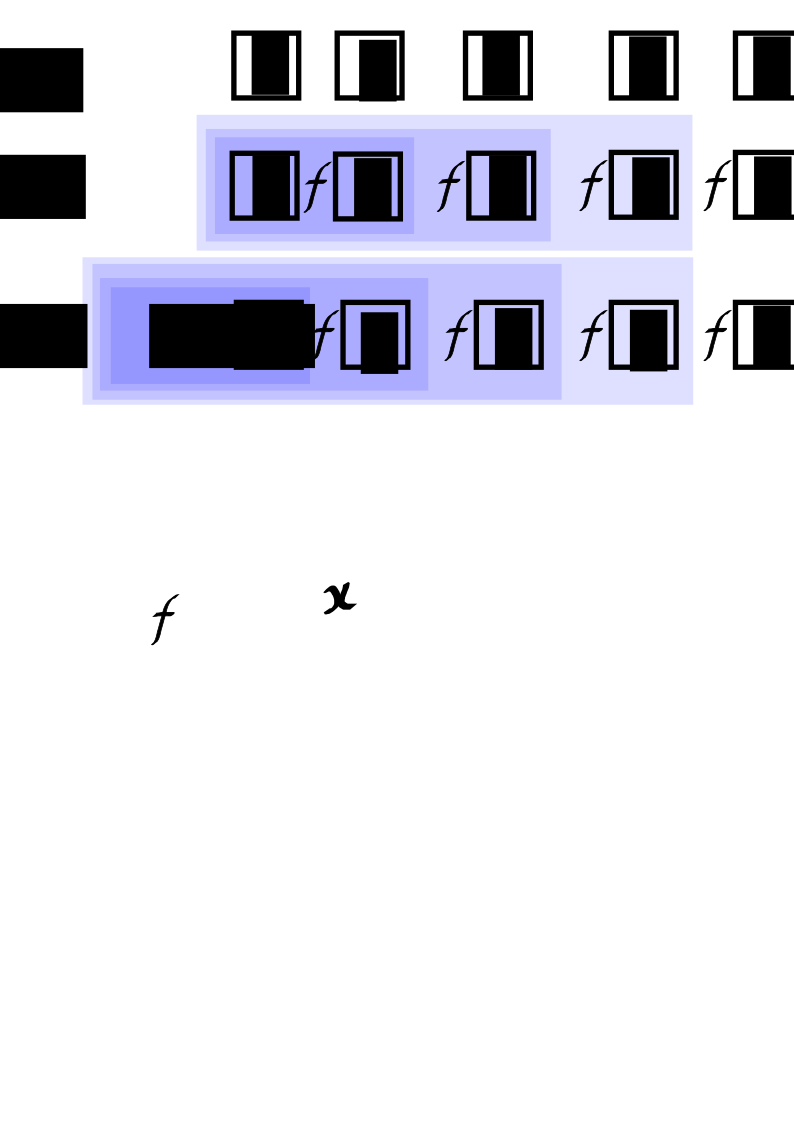
_Unary and binary application of f/_
### Binary application
When the derived function is applied as a binary, the first evaluation applies the value to the function’s left argument and the first item of the its right argument, i.e. `m[x;first y]`. The result of this becomes the left argument in the next evaluation, for which the right argument is the second item of the right argument. And so on.
```q
q)1000+\2 3 4
1002 1005 1009
q)m / finite-state machine
1 6 4 4 2
2 7 2 0 5
7 5 6 7 0
2 1 8 1 0
7 3 3 6 8
2 3 8 9 0
1 1 9 6 9
7 8 4 3 0
4 5 8 0 4
9 8 0 3 9
q)c / columns of m
4 1 3 3 1 4
q)7 m\c
0 6 6 6 1 5
```
Items of `x` must be in the left domain of the value, and items of `y` in its right domain.
### Unary application
When the derived function is applied as a unary, and the value is **a function with a known identity element** $I$, then $I$ is taken as the left argument of the first evaluation.
```q
q)(,\)2 3 4 / I is ()
,2
2 3
2 3 4
```
In such cases `(I f\x)~(f\)x` and `(I f/x)~(f/)x` and items of `x` must be in the right domain of the value.
Otherwise, the first item of the right argument is taken as the result of the first evaluation.
```q
q){x,y}\[2 3 4] / () not known as I
2
2 3
2 3 4
q)42{[x;y]x}\2 3 4 / 42 is the first left argument
42 42 42
q)({[x;y]x}\)2 3 4 / 2 is the first left argument
2 2 2
q)(m\)c / c[0] is the first left argument
4 3 1 0 6 9
```
In this case, for `(v\)x` and `(v/)x`
- `x[0]` is in the _left_ domain of `v`
- items `1_x` are in the _right_ domain of `v`
but `x[0]` need not be in the range of `v`.
```q
q)({count x,y}\)("The";"quick";"brown";"fox")
"The"
8
6
4
```
### Keywords `scan` and `over`
Mnemonic keywords `scan` and `over` can be used to apply a binary value to a list or dictionary.
> **Tip — Parenthesize an infix to pass it as a left argument.**
>
>
```q
q)(+) over til 5 / (+/)til 5
10
q)(+) scan til 5 / (+\)til 5
0 1 3 6 10
q)m scan c / (m\)c
4 3 1 0 6 9
```
[`over`, `scan`](over.md)
## Ternary values
```syntax
v\[x;y;z] v/[x;y;z]
```
The function an accumulator derives from an value of rank >2 has the same rank as the value.
Functions derived by Scan are uniform; functions derived by Over are aggregates.
The number of evaluations is the maximum of the count of the right arguments.
For `v\[x;y;z]` and `v/[x;y;z]`
- `x` is in the left domain of `v`
- `y` and `z` are atoms or conforming lists or dictionaries in the right domains of `v`
The first evaluation is `v[x;first y;first z]`. Its result becomes the left argument of the second evaluation. And so on. For `r:v\[x;y;z]`
```txt
r[0]: v[x ; y 0; z 0]
r[1]: v[r 0; y 1; z 1]
r[2]: v[r 1; y 2; z 2]
…
```
The result of `v/[x;y;z]` is simply the last item of the above.
`v/[x;y;z]`
: v[v[… v[ v[x;y0;z0] ;y1;z1]; … yn-2;zn-2]; yn-1;zn-1]
```q
q){x+y*z}\[1000;5 10 15 20;2 3 4 5]
1010 1040 1100 1200
q){x+y*z}\[1000 2000;5 10 15 20;3]
1015 2015
1045 2045
1090 2090
1150 2150
q)/ Chinese whispers
q)s:"We are going to advance. Send reinforcements."
q)ssr\[s;("advance";"reinforcements");("a dance";"three and fourpence")]
"We are going to a dance. Send reinforcements."
"We are going to a dance. Send three and fourpence."
```
The above description of functions derived from ternary values applies by extension to values of higher ranks.
### Alternative syntax
As of V3.1 2013.07.07, Scan has a built-in function for the following.
```q
q)a:1000f;b:1 2 3 4f;c:5 6 7 8f
q){z+x*y}\[a;b;c]
1005 2016 6055 24228f
q)a b\c
1005 2016 6055 24228f
```
Note that the built-in version is for floats.
## Empty lists
> **Warning — Accumulators can change datatype**
>
>
In iterating through an empty list **the value is not evaluated.**
The result might not be in the range of the value.
Allow for a possible change of type to `0h` when scanning or reducing lists of unknown length.
```q
q)mt:0#0
q)type each (mt;*/[mt];{x*y}/[mt]) / Over can change type
7 -7 0h
q)type each (mt;*\[mt];{x*y}\[mt]) / so can Scan
7 -7 0h
```
### Scan
The function Scan derives from a non-unary value is a uniform function: for empty right argument/s it returns the generic empty list.
It does not evaluate the value.
```q
q)()~{x+y*z}\[`foo;mt;mt] / lambda is not evaluated
1b
```
### Over
The function that Over derives from a non-unary value is an aggregate: it reduces lists and dictionaries to atoms.
For empty right argument/s the atom result depends on the value and, if the derived function is variadic, on how it is applied.
If the value is a **binary function with a known identity element** $I$, and the derived function is applied as a unary, the result is $I$.
```q
q)(+/)mt / 0 is I for +
0
q)(*/)mt / 1 is I for *
1
```
If the value is a **binary function with no known identity element**, and the derived function is applied as a unary, the result is `()`, the generic empty list.
```q
q)()~({x+y}/)mt
1b
```
If the value is a **list** and the derived function is applied as a unary, the result is an empty list of the same type as the list.
```q
q)type 1 0 3h/[til 0]
5h
q)type (3 4#til 12)/[0#0]
0h
```
Otherwise, the result is the left argument.
```q
q)42+/mt
42
q){x+y*z}/[42;mt;mt]
42
q)42 (3 4#til 12)/[0#0]
42
```
The value is not evaluated.
```q
q)`foo+/mt
`foo
q){x+y*z}/[`foo;mt;mt]
`foo
```
_Q for Mortals_
[§6.7.6 Over (/) for Accumulation](../learn/q4m/6_Functions.md/#676-over-for-accumulation)